
Data lake tables

A Delta, Iceberg or Hudi table is a folder, and the folder itself says which of the parquet files inside it the table is currently made of. So the path is the whole SQL surface — name the folder and it answers:
SELECT region, sum(amount) FROM 's3://sales-eu/orders' GROUP BY regionThere is no delta_scan() or iceberg_scan() to remember. A quoted path straight after FROM or JOIN is sniffed — a _delta_log beside the files, a metadata/ of metadata.json, a .hoodie — and rewritten into the query that really reads it before DuckDB sees a character of it.
As of now, not a pile of files
| What it takes to be right | |
|---|---|
| Delta | partition columns live in the log rather than in the parquet, column mapping names the physical columns by uuid, and a deletion vector marks rows inside a file that is otherwise live |
| Iceberg | schema evolution is resolved by field id, so a renamed column still reads and an added one reads as its default; position deletes, equality deletes and deletion vectors each become their own anti-join |
| Hudi | a merge-on-read slice stacks its base file under the log files written over it, and the last write of each record key wins |
A table with none of that — the common one — comes out as a single scan over a file list, which is all it should ever have been.
Hive-partitioned exports and YYYY/MM/DD date prefixes read as one table the same way.
The metadata is readable too
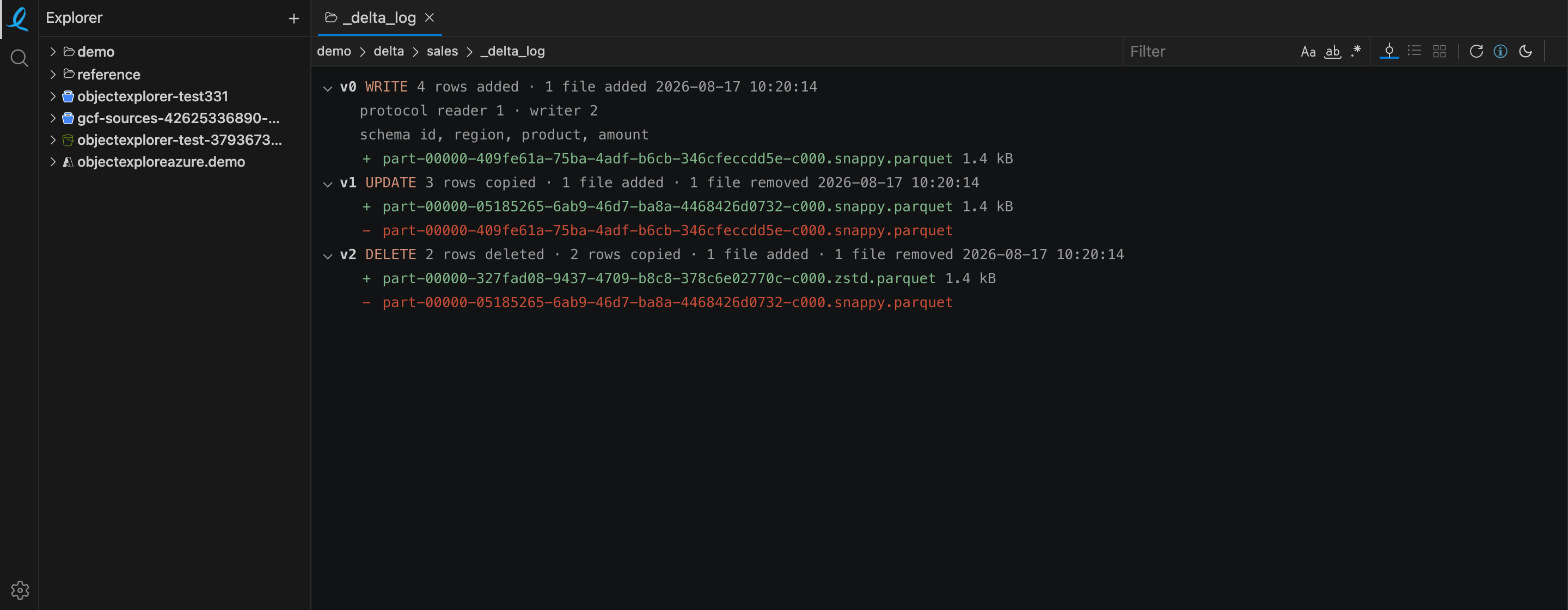
_delta_log opens as the commit history, every version with the files it added and removed underneath it. .hoodie opens as the timeline, including the requested and inflight instants a writer that died left behind. An Iceberg metadata/ opens as the chain it really is — metadata.json, snapshot, manifest list, manifest, and the data and delete files at the end of it.
Next: Cloud Logging.